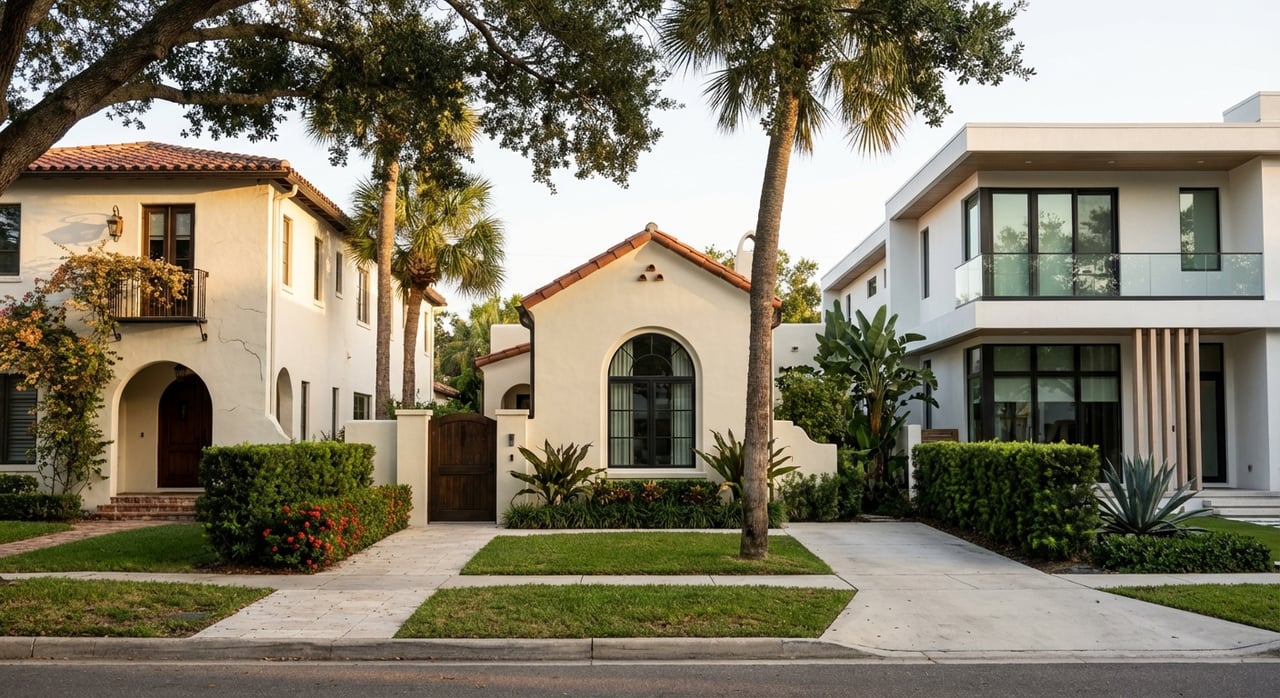
What draws you to Davis Islands might be the sunlit stucco, the red tile rooflines, or the crisp glass of a modern bayfront estate. You want beauty, but you also want to understand how style affects maintenance, insurance, and long-term value. In this guide, you’ll learn how to spot the main architectural styles on the islands, what they mean for ownership, and the due diligence that protects your investment. Let’s dive in.
Why Davis Islands looks this way
1920s vision and plan
Davis Islands began as a 1920s dredge-and-fill project with a resort mindset: hotels, a yacht basin, and even a small airport shaped the plan. That era’s taste brought a strong Mediterranean and Spanish influence to early homes and landmark buildings. The result is a neighborhood where architecture and leisure have always gone hand in hand. You can see the foundation of that vision in the city’s neighborhood overview of the islands’ origin and amenities, including Peter O. Knight Airport and village storefronts on East Davis Boulevard, which frame daily life on the islands. For background, review the City of Tampa’s summary of the area’s development history and layout on the Davis Islands neighborhood page.
Historic recognition
A core cluster of 1920s Mediterranean Revival buildings on Davis Islands is documented in a National Register multiple-property group. That recognition helps explain why the neighborhood’s early Spanish and Mediterranean cues feel so consistent when you drive certain blocks. To see the range of documented resources, explore the National Register list of Mediterranean Revival buildings on Davis Islands.
Waterfront layout
From the start, lots were planned close to the water with finger canals and bayfront parcels. That layout influences architecture and engineering choices, from courtyard-focused villas to large modern builds with deep pilings and impact glass. The village spine on East Davis Boulevard keeps daily needs close, while small yacht basins reinforce the boating lifestyle that defines the islands.
Spot the main styles
Mediterranean Revival cues
If you love the 1920s look, you’ll recognize it fast. Think smooth stucco walls, low-pitched hipped roofs finished in red or orange barrel clay tiles, and arches at entries and windows. Wrought-iron balconies, patterned tile accents, and shaded loggias or courtyards complete the picture. Many of these features are both beautiful and practical in Florida’s climate, offering shade and airflow. For a visual primer, review these hallmark traits of Spanish-influenced homes on HGTV’s overview of Spanish Colonial architecture.
What to look for in photos and in person: intact clay tile roofs with crisp eave lines, plaster or stucco in good repair, arched doorways, and an entry that flows into a courtyard or loggia. Notable local examples include the Palace of Florence and courtyard-focused residences near Davis Boulevard and along Blanca and Adalia streets.
Mission and 1920s apartments
Some smaller 1920s buildings borrow Mission-inspired parapets and simplified ornament. You’ll still see stucco and clay tile, but massing is cleaner and more compact, especially in early apartment courts and mixed-use buildings near the village streets. A number of these appear in the National Register listing for Davis Islands’ Mediterranean Revival resources.
Mid-century and post-war homes
Between the 1940s and 1960s, the islands saw simpler stucco houses and true mid-century modern homes. Expect cleaner lines, larger panes of glass, and more open plans compared to the intricate 1920s villas. These homes appear as infill throughout the islands and offer a lighter, modernist counterpoint to early Mediterranean fabric.
Contemporary waterfront estates
Today’s bayfront showpieces are engineered for coastal resilience and panoramic views. You’ll see poured concrete and steel frames, deep pilings, elevated living levels that address flood standards, and full-height impact glazing. These custom homes sit at the top of the market and often command record prices when combined with prime water frontage. As one high-profile example of Davis Islands’ draw at the top end, Derek Jeter’s Tampa mansion on the islands sold for $22 million, as covered by the Los Angeles Times.
Style, value, and resale
Two value stories run in parallel on Davis Islands. First are the original 1920s Mediterranean and Spanish Revival homes, prized for historic character and proximity to the village streets. Second are bespoke modern estates on the water, built for engineering performance and indoor-outdoor living at scale. Both attract strong demand, but for different reasons: one for charm and context, the other for land, water frontage, and construction pedigree. If you are deciding between them, weigh location, lot features, and your appetite for maintenance versus turnkey engineering.
Maintenance by style
Mediterranean care
Clay tile roofs and stucco walls can be long-lasting when maintained by specialists. Plan for periodic stucco repair or recoating and careful attention to flashing and roof-wall junctions. On bayfront parcels, salt, UV, and humidity accelerate wear on metal elements, which may require more frequent service. For material traits and why these details matter in warm climates, review HGTV’s Spanish Colonial overview.
Modern estate upkeep
Newer estates can reduce some routine repairs thanks to modern systems and materials, but they introduce other realities. Impact glazing, multi-zone HVAC, elevators or lifts, and deep-pile foundations require expert vendors and planned maintenance. Expect higher lifecycle costs that scale with square footage, glass area, and waterfront infrastructure like docks and seawalls.
Seawalls and docks
Nearly every waterfront owner becomes familiar with marine inspections and seawall upkeep. Replacement or major repairs are significant projects that require engineering and permits, and costs vary widely based on site conditions and method. The EPA notes that shoreline protection choices range from bulkheads to revetments and living shorelines, each with distinct implications and budget ranges. For a policy and cost context, see the EPA’s shoreline protection discussion in this EPA technical document.
Flood, insurance, and resilience
Many Davis Islands parcels sit within FEMA Special Flood Hazard Areas, which means lenders typically require flood insurance and buyers should verify the property’s Base Flood Elevation. Ask for an Elevation Certificate early, since it helps underwriters and can influence premiums. For what an Elevation Certificate provides and how it is used, review the OMB’s guidance on elevation certificates.
Tampa Bay area planning also recognizes ongoing sea level rise and increased inundation risk. Factor that context into long-term ownership and mitigation strategies, especially for waterfront parcels. For a regional view of planning recommendations, read this WUSF summary of sea level rise planning in Tampa.
Rules and permits
If you plan renovations, additions, or shoreline work, build your team early and confirm the review path.
- Historic properties: The City of Tampa’s Historic Preservation program oversees designation and design review for locally protected resources. If a property is locally designated, exterior work typically requires a certificate of appropriateness. Start with the organizations and contacts listed by Tampa Preservation, then confirm parcel-level status with the city before you draft plans.
- Seawalls and docks: Shoreline work usually involves state and sometimes federal review, along with city building permits. Expect to coordinate engineering and environmental compliance. For a sense of routine activity and permit scope, browse the Florida DEP permit database for Hillsborough County.
Practical buyer checklist
- Confirm flood zone, FIRM panel, and BFE. Ask the seller for the Elevation Certificate and current flood insurance details. See the OMB elevation certificate guidance.
- Order inspections tailored to the home. For older stucco and tile-roof homes, use contractors experienced with clay tile and coastal stucco. For waterfront homes, add a marine inspection for docks and seawalls. For shoreline cost context, consult the EPA technical overview.
- Check historic status early. If locally designated, expect design review. Start with Tampa Preservation resources and verify with the city.
- Plan permits for marine work. If you will alter a seawall or dock, consult marine engineers and review Florida DEP permitting to understand timelines.
A short architectural tour
- Start near East Davis Boulevard to see early 1920s Mediterranean fabric and mixed-use buildings. The village scale, stucco, and clay tile tell the neighborhood’s origin story.
- Drive Blanca and Adalia streets to spot courtyard-focused villas and arched entries that define the 1920s look. Many are included in the National Register list of Davis Islands Mediterranean Revival buildings.
- Continue to canal-front and open-bay streets to see larger custom estates. Look for elevated first floors, deep piles, and window walls that speak to modern engineering and view-driven design.
Quick visual ID
- Mediterranean Revival: stucco walls, red or orange barrel tile roofs, arched openings, wrought iron, tile-inlaid entries, and shaded loggias or courtyards.
- Mission-influenced: stucco with simplified ornament and parapet lines, often on compact apartment or mixed-use buildings.
- Mid-century: clean lines, larger glass, and open plans with simpler stucco forms.
- Contemporary waterfront: elevated massing, full-height impact glass, metal accents, deep pilings, and engineered docks and seawalls.
Ready to explore?
Whether you lean toward a jewel-box 1920s villa or a state-of-the-art waterfront estate, the right advisor helps you read the architecture, the engineering, and the permits behind the view. If you would like a private tour matched to your style, lot preferences, and timeline, connect with Jennifer Zales for discreet, white-glove guidance.
FAQs
What defines Mediterranean Revival homes on Davis Islands?
- Expect stucco walls, red or orange clay tile roofs, arched openings, and courtyards or loggias that suit Florida’s climate, as outlined in this Spanish Colonial style overview.
How do flood zones affect a Davis Islands purchase?
- Many parcels are in FEMA Special Flood Hazard Areas, so lenders often require flood insurance and an Elevation Certificate that documents the home’s relation to Base Flood Elevation; see OMB guidance.
What should I inspect on a seawall before buying?
- Hire a marine specialist to evaluate structural condition, tie-backs, cap integrity, and erosion; seawall work can be significant and often requires permits, as discussed in this EPA shoreline protection brief.
Do historic homes on Davis Islands need special approvals to renovate?
- If the property is locally designated, exterior changes often require design review and a certificate of appropriateness; begin with Tampa Preservation contacts and verify status with the city.
Why do modern waterfront estates look so different from 1920s homes?
- They prioritize engineered resilience and views, with deep pilings, elevated living levels, and impact glass, which differentiates them from the smaller-scale, courtyard-focused 1920s villas.
Is sea level rise considered in local planning?
- Yes. Regional studies and city planning acknowledge sea level rise and recommend resilience strategies for coming decades; see this WUSF summary.